
Introduction: Is the world facing a leadership crisis?
Across boardrooms, governments, universities, and international institutions, one question has become increasingly urgent: What makes a truly great leader?
For decades, leadership has largely been measured by authority, influence, financial success, or political power. Yet recent corporate scandals, declining public trust, geopolitical conflicts, environmental crises, and the ethical dilemmas posed by artificial intelligence reveal an uncomfortable truth—power alone does not create great leadership. In many cases, it exposes the absence of it.
As organizations and societies search for leaders who can inspire trust, make ethical decisions, and balance competing interests, modern leadership theories have evolved to emphasize emotional intelligence, servant leadership, ethical governance, and purpose-driven management. While these ideas are often presented as contemporary innovations, their philosophical foundations have existed for thousands of years.
Ancient India developed one of history’s most comprehensive leadership traditions—one that viewed leadership not as a privilege to command but as a responsibility to serve. Indian civilization taught that a leader’s greatest strength was neither military might nor political authority, but character, wisdom, self-discipline, and commitment to the common good.
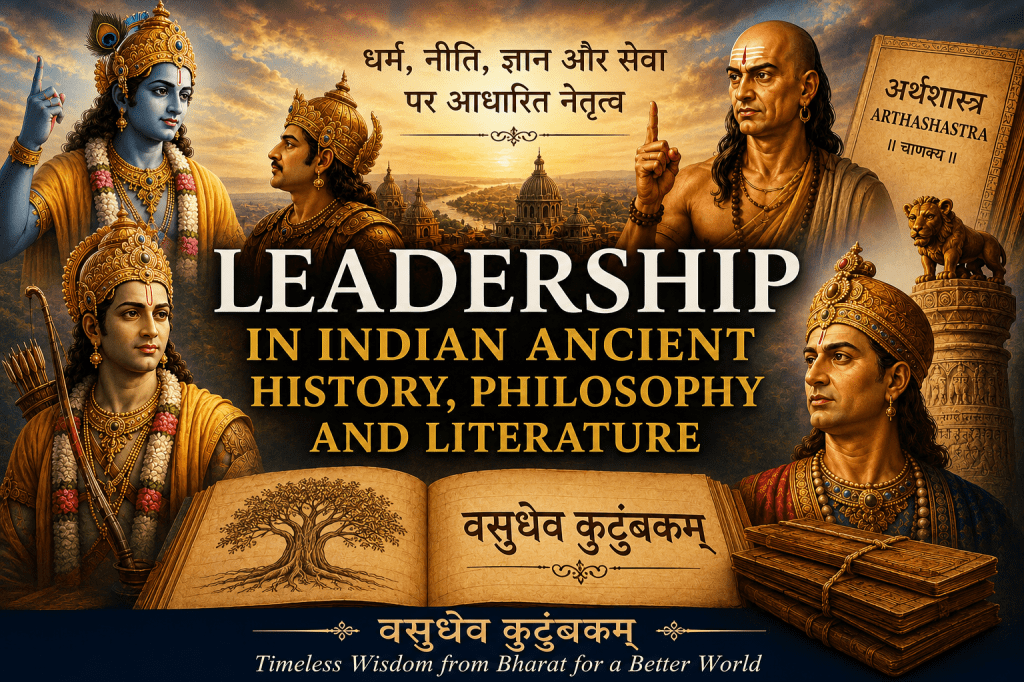
From the unwavering integrity of Lord Rama to the strategic brilliance of Lord Krishna, from Chanakya’s visionary statecraft to Emperor Ashoka’s compassionate governance, India’s civilizational wisdom offers a timeless model of leadership that transcends cultures, religions, and generations.
Today, as the world searches for leaders who can unite rather than divide, these ancient principles deserve renewed attention.
Why Ancient Indian Leadership Is More Relevant Than Ever
The twenty-first century presents leadership challenges unlike any previous era. Globalization has interconnected economies, digital technologies have accelerated decision-making, and artificial intelligence is reshaping industries at an unprecedented pace. At the same time, societies are grappling with political polarization, climate change, widening economic inequality, and declining public trust in institutions.
These challenges cannot be solved through authority alone. They require leaders capable of ethical judgment, long-term vision, emotional resilience, and genuine concern for humanity.
This is precisely where ancient Indian leadership philosophy becomes remarkably relevant.
Unlike many conventional models that focus primarily on acquiring and exercising power, Indian thought begins with a different question:
“Can a person lead others without first mastering themselves?”
For thousands of years, Indian philosophers argued that the quality of external leadership depends upon the quality of inner character. A leader who cannot control greed, anger, ego, or fear will eventually misuse authority, regardless of intelligence or ambition.
This perspective explains why Indian civilization consistently celebrated leaders known not merely for conquest but for wisdom, restraint, and moral responsibility. Leadership was viewed as a sacred trust rather than a personal entitlement.
In today’s interconnected world, where every decision can influence millions of lives, this philosophy is not simply relevant—it is essential.
The Indian Philosophy of Leadership: Character Before Authority
Ancient Indian civilization never defined leadership solely by position or power. Instead, it placed character at the centre of leadership.
A king was expected to protect rather than dominate. A teacher was regarded as a guide rather than an owner of knowledge. A warrior fought not for personal glory but to uphold justice. Leadership was understood as a form of service rooted in responsibility.
This philosophy rests on five enduring principles:
1. Dharma: Duty Before Desire
The Sanskrit concept of Dharma extends beyond religion. It represents righteous duty, moral responsibility, and ethical conduct. A true leader acts according to what is right rather than what is convenient or personally beneficial.
2. Seva: Leadership Through Service
Indian tradition teaches that authority exists to serve society. Leadership is measured not by the privileges it grants but by the positive impact it creates.
3. Self-Mastery
Ancient Indian texts repeatedly emphasize that those who cannot govern themselves cannot govern others. Emotional balance, discipline, humility, and self-awareness are viewed as prerequisites for effective leadership.
4. Wisdom Over Impulse
Leadership requires thoughtful judgment rather than emotional reaction. Decisions should be guided by knowledge, experience, and long-term consequences rather than immediate gain.
5. Lokasangraha: The Welfare of All
One of the most profound ideas in Indian philosophy is Lokasangraha—acting for the well-being and stability of society. Leadership is ultimately judged by its contribution to the collective good.
Together, these principles create a leadership model that is ethical, sustainable, and deeply human.
Lord Rama: Leadership Through Integrity and Duty
Among all figures in Indian civilization, Lord Rama stands as one of the most enduring symbols of principled leadership. Revered not merely as a king but as the embodiment of righteousness, Rama demonstrates that leadership begins with unwavering commitment to duty.
When faced with the choice between personal comfort and moral responsibility, he consistently chose duty. He willingly accepted fourteen years of exile to honor his father’s promise, placing integrity above personal ambition. Even in adversity, he treated allies, opponents, and ordinary citizens with dignity and respect.
Rama’s leadership was rooted in trust. His followers did not obey him out of fear but because they believed in his character. He united diverse communities through fairness, compassion, and accountability, proving that moral authority is often more powerful than political authority.
For modern leaders, Rama offers a timeless lesson: credibility is built through consistent actions, not persuasive words. Organizations, governments, and institutions thrive when leaders demonstrate integrity, accept responsibility, and place the interests of others above personal gain.
In an age where reputations can be built overnight but destroyed in moments, Rama reminds us that character remains the most valuable asset any leader can possess.
Lord Krishna: Strategic Leadership in Times of Crisis
If Lord Rama represents ethical leadership, Lord Krishna exemplifies strategic leadership.
The Mahabharata presents one of history’s most complex moral landscapes, where difficult decisions often involve choosing between competing responsibilities rather than clear distinctions between right and wrong. In this environment, Krishna emerges not as a ruler seeking power but as a mentor guiding others toward wise action.
Rather than issuing commands, Krishna empowers Arjuna to overcome fear, confusion, and self-doubt. Through dialogue, reflection, and practical wisdom, he transforms hesitation into purposeful action.
Krishna demonstrates that leadership is not merely about possessing knowledge; it is about helping others discover clarity amid uncertainty.
His approach combines emotional intelligence with strategic thinking. He understands people, anticipates consequences, adapts to changing circumstances, and remains focused on achieving justice rather than personal recognition. Significantly, he influences the course of history without occupying the throne himself, illustrating that genuine leadership is defined by impact rather than title.
For today’s executives, policymakers, entrepreneurs, and educators, Krishna’s example highlights an essential truth: effective leaders do more than solve problems—they develop the confidence, wisdom, and resilience of those they lead.
His enduring message is simple yet profound: wisdom achieves its greatest purpose when it inspires others to act with courage and responsibility.
Chanakya: Leadership Through Vision and Strategic Governance
If Lord Rama represents ethical leadership and Lord Krishna strategic leadership, Chanakya symbolizes visionary leadership rooted in governance, planning, and institution building.
More than two thousand years ago, Chanakya developed one of the world’s earliest comprehensive frameworks on statecraft, economics, diplomacy, and administration through the Arthashastra. His leadership philosophy was remarkably practical. He believed that good intentions alone were insufficient; leaders also needed competence, foresight, and the ability to make difficult decisions for the greater good.
Chanakya argued that effective leadership rests on four essential pillars: vision, merit, discipline, and national welfare. He encouraged leaders to select capable individuals rather than merely loyal followers, emphasizing that institutions become strong when talent is valued above favoritism. He also viewed strategic planning as a moral responsibility, warning that leaders who fail to anticipate future risks place entire societies in danger.
In today’s world of rapidly changing economies, technological disruption, and geopolitical uncertainty, Chanakya’s insights remain strikingly relevant. Successful organizations are built not only on inspiring leadership but also on sound governance, accountability, and long-term thinking.
His enduring lesson is clear: great leaders prepare for tomorrow while responsibly managing today.
Emperor Ashoka: The Power of Compassionate Leadership
Few leaders in history demonstrate the transformative power of self-reflection as profoundly as Emperor Ashoka.
Following the devastating Kalinga War, Ashoka witnessed the immense human cost of conquest. Rather than celebrating military victory, he chose a different path—one guided by compassion, ethical governance, and public welfare. This transformation made him one of history’s earliest examples of values-based leadership.
Ashoka redirected the resources of his empire toward education, healthcare, infrastructure, environmental conservation, and religious tolerance. His inscriptions consistently emphasized justice, kindness, and respect for all communities, reflecting an understanding that the true strength of a nation lies not in fear but in the well-being of its people.
Modern leadership often celebrates confidence and certainty. Ashoka reminds us of another equally important quality: the courage to acknowledge mistakes, learn from experience, and evolve. Leaders who remain open to transformation are often those who create the most enduring legacies.
His example demonstrates that compassion is not a weakness—it is a strategic strength that builds trust, unity, and long-term stability.
Leadership Lessons from India’s Wisdom Traditions
Ancient India’s understanding of leadership extends beyond historical figures. Its philosophical traditions explore the inner qualities that enable individuals to lead with wisdom and purpose.
The Bhagavad Gita presents leadership as disciplined action guided by moral responsibility rather than attachment to personal reward. It teaches that leaders must remain calm during uncertainty, perform their duties with integrity, and make decisions based on principles rather than emotions. This philosophy of Karma Yoga encourages excellence without arrogance and commitment without fear of failure.
The Upanishads shift the focus inward. They argue that self-knowledge is the foundation of all meaningful leadership. A person who has not mastered ego, anger, or desire cannot effectively guide others. True influence begins with self-awareness.
Buddhist philosophy introduces the importance of compassion, mindfulness, and emotional balance. Buddha demonstrated that lasting influence arises not through authority but through empathy, patient listening, and service to others. Modern discussions of emotional intelligence and mindful leadership echo these timeless teachings.
Similarly, Jain philosophy emphasizes self-discipline, non-violence, truthfulness, and restraint. It teaches that the most powerful leaders are those who inspire through their conduct rather than compel through force.
Sikh Philosophy: adds a powerful dimension to Indian leadership thought through Seva (selfless service), equality, honest work, humility, and courage.
The Sikh tradition teaches that leadership is not about superiority but about serving humanity. Langar represents equality, while the ideal of the Sant-Sipahi (saint-soldier) combines spiritual discipline with the courage to stand against injustice.
Together, these traditions reveal a remarkable insight: leadership is not merely an external skill but an inner discipline. Before leading an organization, a nation, or a movement, one must first learn to lead oneself.
Seven Timeless Principles of Ancient Indian Leadership:
Although ancient Indian leadership emerged in a very different historical context, its core principles remain surprisingly relevant for today’s interconnected world.
1. Duty Before Power
Leadership is a responsibility, not a privilege.
2. Character Before Reputation
Integrity builds trust, and trust sustains leadership.
3. Service Before Authority
Great leaders exist to serve a larger purpose than themselves.
4. Wisdom Before Action
Thoughtful judgment is more valuable than impulsive decisions.
5. Self-Mastery Before Leadership
Those who cannot govern themselves cannot effectively lead others.
6. Justice Before Success
Short-term victories achieved without ethics rarely create lasting progress.
7. Collective Good Before Personal Gain
The ultimate measure of leadership is its contribution to society.
These principles explain why Indian civilization consistently viewed leadership as a moral and social responsibility rather than a means of acquiring power.
Conclusion: Leadership Begins Within
The challenges facing today’s world are increasingly complex. Technological disruption, environmental uncertainty, geopolitical instability, and social divisions demand leaders who possess not only intelligence but also wisdom, integrity, and compassion.
Ancient India’s leadership tradition offers a powerful reminder that sustainable leadership cannot be built on authority alone. It begins with character, is strengthened by self-discipline, guided by ethical responsibility, and fulfilled through service to others.
Lord Rama teaches the importance of integrity. Lord Krishna demonstrates strategic wisdom and emotional resilience. Chanakya reveals the necessity of vision and effective governance. Emperor Ashoka reminds us that compassion can transform both leaders and societies. The Bhagavad Gita, the Upanishads, Buddhist teachings, and Jain philosophy collectively affirm one timeless truth: the greatest victory a leader can achieve is mastery over oneself.
While the tools of leadership have evolved over the centuries, its essence has not. Organizations still seek trustworthy executives. Nations still need ethical statesmen. Communities still look for individuals who inspire hope rather than fear.
The future will not belong merely to those who accumulate the greatest power. It will belong to those who cultivate the greatest character.
Ancient Indian wisdom therefore offers more than historical insight—it provides a timeless blueprint for leadership in the modern world. It reminds us that true leaders do not simply command people; they elevate them. They do not seek authority for its own sake; they use it to serve a higher purpose. And they understand that the most enduring legacy is not the power they held, but the values they left behind.
As ancient Indian philosophy teaches, the person who learns to govern the self becomes capable of guiding the world.




Leave a Reply